
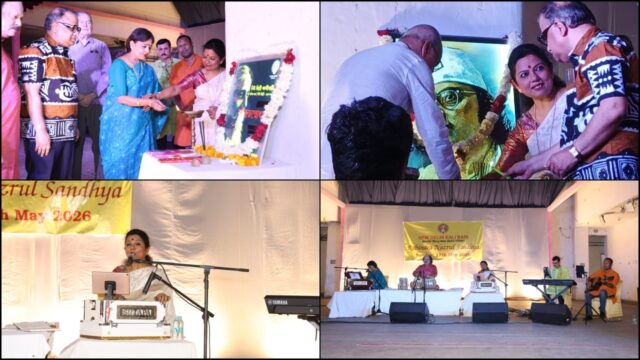
DILIP GUHA, New Delhi: A cultural programme marking the birth anniversaries of Nobel laureate Rabindranath Tagore and Bangladesh’s national poet Kazi Nazrul Islam was held at New Delhi Kalibari this Sunday, 17th May,2026, drawing together music, poetry, and cross-border heritage.
Renowned singers Susmita Goswami and Sutapa Bhattacharya, both from Kolkata, performed a selection of Tagore and Nazrul songs, accompanied by Pandit Pradeep Ghosh, on Key board Rajive Mukherjee, and on Guitar Deepdipto Das.
The evening brought alive the timeless compositions of the two poets, whose work continues to resonate across generations.
Vocalist Sutapa Bhattacharya delivered a carefully curated performance at the New Delhi Kali Bari’s “Rabindra–Nazrul Sandhya,” weaving together themes of devotion, remembrance, spiritual longing, prem, and Bengali cultural aesthetics.
Opening with Tagore’s devotional _Puja Parjay_ song _“Ami Hethay Thaki Shudhu Gaite Tomar Gaan”, Sutapa set a meditative tone, expressing surrender to the Divine and sanctifying the evening. She followed with the Rabindra Sangeet _“Mone Robe Ki Na Robe Amare”, a meditation on memory and impermanence.
The programme transitioned into Nazrul’s repertoire with “Arun-Kanti Ke Go Yogi Bhikhari”_, invoking Shiva in a mystic, ascetic form, and _“Hridoyer E Kul, O Kul, Du Kul Bhese Jay”_, a song steeped in emotional overflow. Lighter yet poetic notes came through _“Tumi Sundor Tai Cheye Thaki Priyo”, where Nazrul playfully questions whether gazing at beauty is a crime.
Sutapa then moved into Nazrul’s spiritual and devotional works, performing _“Tomari Jhornatolar Nirjone”_ and the Shyama Sangeet-inspired _“Amar Kalo Meye Rag Koreche”_, a tribute to Goddess Kali. The set concluded with _“Kaveri Nodi-Jole Ke Go Balika”, one of Nazrul’s most lyrical and graceful compositions.
Renowned singer Susmita Goswami also delivered a captivating musical performance at the Rabindra–Nazrul Sandhya organised at New Delhi Kalibari, enthralling the audience with a soulful blend of Rabindra Sangeet, devotional melodies, and Bengali folk classics.
The evening witnessed an overwhelming response from music lovers as Susmita showcased her versatility, emotional depth, and command over traditional Bengali music. Her rendition of “Amar Haat-e Kali Mukhe Kali” opened the programme on a vibrant note, while the devotional composition “Brojo Gopi Khele Hari” filled the auditorium with spiritual fervour and festive energy.
One of the highlights of the evening was her heartfelt presentation of Rabindranath Tagore’s immortal classic “Bhalobese Sokhi Nibhrite Jotone,” which drew prolonged applause from the audience for its emotional expression and lyrical grace.
Susmita further captivated listeners with the monsoon-themed melody “Shawon Raate Jodi Bahire Jhor Boye,” creating an atmosphere of nostalgia and romantic longing through her expressive vocals and nuanced performance.
Adding a touch of folk vibrancy to the evening, she performed “Ami Moyna Moti Shari Debo,” bringing warmth and rhythmic charm to the cultural gathering. The programme concluded on an emotional note with “Amar Jabar Somoy Holo Dao Bidaye,” leaving the audience deeply moved by the poignant farewell composition.
The performance was praised for its seamless blend of Tagore and Nazrul, reflecting the shared cultural and spiritual heritage of Bengal. Both the artist’s nuanced voice, emotional depth, and sensitivity to the spiritual and romantic textures of both Tagore and Nazrul made the evening unforgettable.
For lovers of Bengali music, “Rabindra–Nazrul Sandhya” was a soulful journey through devotion, love, and cultural memory.
Attendees praised Sutapa and Susmita’s performance for maintaining the rich heritage of Bengali music and beautifully blending devotion, romance, folk tradition, and emotion into a memorable cultural evening.
Organisers stated that the event aimed to highlight the enduring cultural bond between India and Bangladesh. “The two poets continue to hold a special place in the hearts of people in both countries,” one organiser remarked. “The admiration for Tagore and Nazrul serves as one of the strongest symbols of the shared cultural heritage between India and Bangladesh.”
The program was attended by members of the Bengali community in the Delhi NCR region, as well as cultural enthusiasts, who regarded it as a reminder of how music and literature can transcend political borders.
Such evenings at New Delhi Kali Bari preserve the living heritage of Bengali music outside Bengal and create a cultural bridge between spirituality, literature, and performance.