
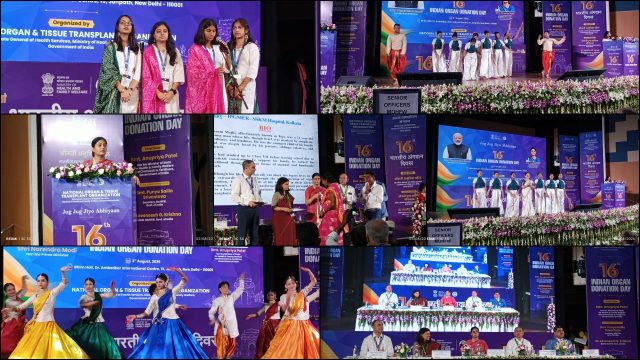
Dilip Guha, New Delhi: The 16th Indian Organ Donation Day was observed on Monday with a powerful and inspiring message: organ donation is not only the highest expression of human compassion but also one of the most sustainable legacies a person can leave behind. Framing organ donation as the “ultimate green legacy,” the event encouraged citizens to look beyond conventional notions of environmental responsibility and recognise that the gift of life is perhaps the most meaningful form of sustainability.
Hosted by the National Organ and Tissue Transplant Organisation (NOTTO) under the Directorate General of Health Services, Ministry of Health and Family Welfare, Government of India, the ceremony at the Dr Ambedkar International Centre brought together donor families, transplant recipients, healthcare professionals, policymakers, hospitals, and organ donation advocates from across the country. The gathering celebrated the remarkable progress India has made in organ transplantation while renewing the national commitment to strengthening awareness, transparency and public participation in organ donation. The programme formed part of NOTTO’s nationwide “Angdaan Jan Sanjeevani Abhiyaan” and Organ Donation Month 2026, while also commemorating India’s first successful heart transplant following the enactment of the Transplantation of Human Organs Act (THOA), 1994.
The event also served as a heartfelt tribute to the silent heroes of the organ donation movement. Families of deceased organ donors were honoured for their extraordinary courage and generosity, while transplant professionals, hospitals, Regional Organ and Tissue Transplant Organisations (ROTTOs), States and Union Territories were recognised for their outstanding contributions to strengthening India’s organ donation and transplantation ecosystem.
The ceremony was graced by Union Minister of State for Health & Family Welfare and Chemicals & Fertilisers, Smt. Anupriya Patel, as the Chief Guest. She was joined by Union Health Secretary Smt. Punya Salila Srivastava, Director General of Health Services Dr Loveneesh G. Krishna, Director, NOTTO, Dr Anil Kumar, senior officials of the Ministry of Health and Family Welfare, representatives of States and Union Territories, transplant recipients, donor families and healthcare professionals.
Organ Donation: The Highest Expression of Humanity
Addressing the gathering, Smt. Anupriya Patel described the occasion as a celebration of service, compassion and humanity. She said organ donation represents the highest form of selfless giving, offering a second chance at life to patients suffering from end-stage organ failure. Expressing profound gratitude to the families of deceased donors, she acknowledged that their courageous decisions have inspired the nation and strengthened India’s growing organ donation movement. She also commended the efforts of State Governments and urged them to continue sharing best practices to further improve organ donation and transplantation services across the country.
Highlighting India’s remarkable achievements, the Minister announced that the country has crossed five lakh Aadhaar-verified organ donation pledges since the launch of the National Digital Pledge Portal in 2023. She attributed this milestone to sustained awareness campaigns undertaken by the Government and to Prime Minister Shri Narendra Modi’s repeated appeals encouraging citizens to embrace organ donation and support the timely transportation of organs to patients awaiting life-saving transplants.
India’s progress in organ transplantation, she noted, has been unprecedented. The number of organ transplants has increased from 4,990 in 2013 to more than 20,000 in 2025—the highest ever recorded in a single year. Today, India ranks third globally in the total number of organ transplants, after the United States and China, while deceased donor transplants have risen from 837 in 2013 to over 3,500 in 2025. At the same time, she acknowledged that a considerable gap still exists between the demand for organs and their availability, making wider public participation an urgent national priority.
The Minister also addressed one of the greatest barriers to organ donation—misconceptions and social myths. Stressing that no major religion prohibits organ donation, she said all faiths uphold the values of compassion, service and saving lives, making organ donation a noble humanitarian act that transcends religious and social boundaries.
Landmark Initiatives to Strengthen India’s Organ Donation Ecosystem
The occasion witnessed the launch of several transformative initiatives aimed at making India’s organ donation and transplantation programme more transparent, efficient and accessible.
Among the highlights was the launch of the ‘Jug Jug Jiyo Abhiyaan (जुग जुग जियो अभियान)’, a year-long nationwide awareness campaign designed to take the message of organ donation to every village and community across India. Reinforcing the belief that organ donation is the greatest gift of life, the campaign seeks to ensure that the legacy of every donor continues to live on through recipients.
The Minister also launched ‘e-प्रत्यारोपण’, a unified national digital platform integrating hospitals, doctors, donors, recipients and transplant authorities onto a single transparent, technology-driven network. Designed to streamline registration, waiting lists, organ allocation, monitoring and public information, the platform marks a major step towards a more accountable and efficient transplantation ecosystem. Complementing this initiative, the NOTTO Mobile Application was introduced to make organ donation and transplantation services more accessible to citizens, healthcare professionals and administrators alike.
Further strengthening the policy framework, the Government released the National Brain Stem Death Certification Guidelines and the National Guidelines on Swap Transplantation, which are expected to standardise medical practices, improve transparency and help States and Union Territories implement robust, ethical and efficient organ donation programmes.
The Minister also highlighted the Government’s continued investment in strengthening transplant infrastructure under the National Organ Transplant Programme (NOTP). Financial assistance is being extended to States for donor maintenance, organ retrieval, transportation and infrastructure development. She noted that kidney transplantation has been included under the Ayushman Bharat Pradhan Mantri Jan Arogya Yojana (AB PM-JAY), while financial support is also available for economically weaker patients through the Rashtriya Arogya Nidhi. Access to affordable post-transplant medicines has also improved significantly through the expanding network of Jan Aushadhi Kendras across the country.
Concluding her address, Smt. Patel emphasised that while expanding transplantation services remains essential, India’s long-term goal should also be to reduce the incidence of organ failure through disease prevention and healthier lifestyles. Referring to initiatives such as Yoga, the Fit India Movement, and the recently launched Nasha Mukt Bharat campaign, she urged citizens—particularly the youth—to adopt healthier habits, noting that prevention remains the most effective means of reducing the burden of chronic diseases that often lead to organ failure.
Celebrating Progress, Honouring Heroes, and Inspiring a Nation
While the day celebrated India’s remarkable progress in organ transplantation, it also served as a tribute to the countless individuals and institutions whose commitment has transformed the country’s organ donation movement into one of the world’s fastest-growing healthcare initiatives. Government leaders highlighted the need to strengthen systems, inspire greater public participation, and ensure that every eligible organ donation translates into a life saved.
Addressing the gathering, Union Health Secretary Smt. Punya Salila Srivastava expressed heartfelt gratitude to donor families, transplant recipients, healthcare professionals, hospitals, Regional Organ and Tissue Transplant Organisations (ROTTOs), State Organ and Tissue Transplant Organisations (SOTTOs), and all stakeholders whose collective efforts have strengthened India’s organ donation movement over the years.
She noted that the initiatives launched on the occasion—including the e-प्रत्यारोपण digital platform, the NOTTO Mobile Application, the National Brain Stem Death Certification Guidelines, and the National Guidelines on Swap Transplantation—would simplify procedures, improve transparency, enhance coordination among stakeholders, and further strengthen the country’s organ donation and transplantation ecosystem.
Highlighting the rapid expansion of the national transplant network, the Health Secretary said that the NOTTO–ROTTO–SOTTO network now spans 31 States and Union Territories, enabling more efficient coordination for organ procurement and allocation across hospitals. She also pointed out that the Government has decentralised the process for hearing appeals, making the system faster, more transparent and time-bound.
She further underlined the expansion of advanced transplant services across the country. In addition to AIIMS New Delhi, ten newly established AIIMS institutions are now performing kidney transplants. Among them, AIIMS Jodhpur, AIIMS Bhubaneswar, AIIMS Patna and AIIMS Rishikesh have initiated liver transplantation programmes, while AIIMS Bhopal has successfully commenced heart transplantation services—bringing advanced organ transplant care closer to patients across different regions of India.
Recalling Prime Minister Shri Narendra Modi’s observation during the 131st episode of Mann Ki Baat that awareness about organ donation is steadily increasing, she said the newly launched ‘Jug Jug Jiyo Abhiyaan’ embodies that vision and would help take the message of organ donation to every corner of the country. She urged States and Union Territories to fully utilise the support available under the National Organ Transplant Programme to further expand organ donation services.
Delivering the vote of resolve for the future, Director General of Health Services Dr. Loveneesh G. Krishna described the 16th Indian Organ Donation Day as a day of gratitude dedicated to honouring organ donors and their families while celebrating the gift of life. He recalled that the day commemorates India’s first successful deceased organ transplant performed on 3 August 1994, and said the initiatives launched during the ceremony would strengthen the organ donation ecosystem through greater awareness, improved coordination and enhanced transparency. Appealing directly to citizens, he urged everyone to pledge their organs and tissues and become active participants in this life-saving movement.
A Digital and Policy Push for the Future
The event marked the launch of a series of landmark initiatives designed to transform India’s organ donation programme through technology, policy reforms and nationwide public awareness.
Leading the announcements was the launch of the ‘Jug Jug Jiyo Abhiyaan (जुग जुग जियो अभियान)’, a year-long nationwide campaign aimed at taking the message of organ donation to every village and community in India. The campaign reinforces the belief that organ donation is the greatest gift of life and that the legacy of every donor lives on through those whose lives are saved.
The Government also introduced e-प्रत्यारोपण, a secure, transparent and technology-driven digital platform integrating hospitals, doctors, donors, recipients and transplant authorities into a single nationwide network. Together with the newly launched NOTTO Mobile Application, these initiatives are expected to make organ donation services more efficient, accessible and transparent for both healthcare providers and the public.
Further strengthening the national framework, the National Brain Stem Death Certification Guidelines and the National Guidelines on Swap Transplantation were released to support ethical, uniform and scientifically robust transplant practices across the country.
India’s Record-Breaking Progress
One of the highlights of the ceremony was the release of the NOTTO Annual Report 2025–26, which documented India’s remarkable achievements in organ donation and transplantation.
According to the report, the country recorded 20,138 organ transplants in 2025—the highest ever achieved in a single year—representing a fourfold increase from 4,990 transplants in 2013 and a 6.5 per cent rise over 2024. India continues to retain the world’s leading position in living donor organ transplants while ranking third globally in the total number of organ transplants. Deceased donor transplants also witnessed remarkable growth, increasing more than fourfold from 837 in 2013 to 3,526 in 2025. The report further revealed that over 2.58 lakh citizens pledged to donate their organs and tissues during the year, reflecting steadily growing awareness and public participation in the national movement.
The latest edition of the NOTTO e-Newsletter, documenting the achievements, innovations and best practices of NOTTO, ROTTOs and SOTTOs during the year, was also released on the occasion.
Honouring Excellence Across India
Recognising excellence in organ donation and transplantation, the National Organ Donation Awards were presented to States, Union Territories, Regional Organ and Tissue Transplant Organisations, hospitals, transplant professionals and other stakeholders for their outstanding contribution to strengthening India’s organ donation ecosystem.
Among the major honours, PGIMER, Chandigarh received the award for Best Regional Organ and Tissue Transplant Organisation (ROTTO) – Northern Region. Tamil Nadu was recognised as the Best State for recording the highest number of deceased organ donors, while Assam received the award for Best State in the North Eastern Region. Delhi was honoured as the Best Union Territory. Awards were also presented to hospitals, transplant professionals and other stakeholders in recognition of their exemplary contribution towards advancing the national organ donation programme.
A Tribute to the Heroes Who Gave the Gift of Life
Beyond the statistics, policy announcements and technological advancements, the most emotional moments of the 16th Indian Organ Donation Day belonged to the donor families—ordinary people whose extraordinary decisions transformed personal tragedy into the gift of life. Their courage reminded everyone present that behind every successful transplant lies a story of love, sacrifice and hope.
Honouring the Families Who Chose Hope Over Grief
One of the most poignant segments of the ceremony was a heartfelt tribute to deceased organ donors and the remarkable resilience of their families. Around ten donor families from different parts of the country were felicitated for their invaluable contribution to humanity. Their selfless decisions, taken at moments of unimaginable grief, have given countless patients a second chance at life and inspired thousands more to consider organ donation.
Among the stories that moved the audience to silence was that of Biswajit Maji and his wife from West Bengal. Their young son tragically lost his life after sustaining severe head injuries in a road accident while trying to avoid hitting a pedestrian on his two-wheeler. Despite receiving the best possible treatment at the Trauma Care Centre of IPGMER and SSKM Hospital, Kolkata, doctors were unable to save him, and he was declared brain dead.
In the midst of overwhelming grief, the couple made a decision that transformed despair into hope. With extraordinary courage and compassion, they consented to donate their son’s vital organs, enabling four critically ill patients to receive a new lease of life. The successful retrieval and transplantation of his organs became a landmark achievement for deceased organ donation coordinated through ROTTO (East) in West Bengal. Their story stood as a powerful reminder that even in life’s darkest moments, one act of generosity can illuminate many lives and leave behind a legacy that transcends loss.
Art That Touched Hearts
The message of organ donation found moving expression through a series of cultural performances that blended artistic excellence with social awareness, transforming the ceremony into a deeply emotional celebration of life, hope and humanity.
A troupe from the Sangeet Natak Akademi enthralled the audience with a graceful Kathak recital that symbolised the continuity of life, resilience of the human spirit and the enduring power of compassion. The classical performance added a reflective and uplifting dimension to the programme.
Adding another emotional layer to the evening, medical students from Lady Hardinge Medical College presented a soulful musical narration on organ donation. Through moving lyrics, heartfelt storytelling and evocative music, they paid tribute to organ donors and their families while sensitively conveying the life-changing impact of transplantation. Their performance inspired the audience to look at organ donation not merely as a medical procedure, but as a profound act of humanity capable of restoring hope to countless families.
The cultural programme reached its emotional crescendo with a powerful dance-drama on organ donation presented by students of Shinjan Dance Academy under the direction of Smita Chakraborty.
The production narrated the poignant story of Kritika, a devoted wife and mother of two young children, whose life changed forever after she suffered a severe brain injury in an accident. When doctors declared her brain dead, the performance sensitively portrayed the emotional conflict faced by her husband, an Army Colonel, and other family members as they struggled with the agonising decision of donating her organs while coping with their irreparable loss.
Through compelling choreography, evocative music and deeply expressive performances, the production illustrated how one family’s courageous decision to donate organs could save several lives. The emotionally charged presentation received a standing ovation, reinforcing the central message that empathy, awareness and timely decisions can transform personal tragedy into enduring hope.
A Reflection on the Gift of Life
Reflecting on the significance of the occasion, Dr Usha Rawat of Vishambhar Das Homoeopathic Dispensary described herself as privileged to witness the launch of the ‘Jug Jug Jiyo Abhiyaan’ on the 16th Indian Organ Donation Day. She noted the remarkable rise in organ transplants across the country and welcomed the growing public awareness, reflected in more than five lakh organ donation pledges.
Expressing deep admiration for donor families, she observed that their willingness to donate the organs of loved ones during the most painful moments of their lives represents one of humanity’s noblest acts. Quoting: “Feeling blessed! It’s a wonderful feeling to witness the launch of Jug Jug Jiyo Abhiyan on 16 Indian Organ Donation Day. There’s a remarkable increase in the number of organ transplants done all over the country. People’s understanding of the need for this noble sacrifice has increased over the years, with over 5 lakh people taking pledges for organ donation. It was overwhelming to offer gratitude to the people who have generously donated their loved one’s organs at their worst hours of grief to give life to other people. What a beautiful way of leaving a legacy of life after life! “ A life is lived not by the years but by the lives it touches “ a donor can save 8 lives. Taking a pledge to donate organs is as important as spreading awareness, as“Ang Dan is Mahadan “”
Organ Donation: The Ultimate Green Legacy
While the event celebrated medical achievements and honoured countless heroes, it also introduced one of its most thought-provoking ideas—the concept of organ donation as the ultimate green legacy.
At a time when conversations on climate change encourage people to plant trees, reduce plastic use, conserve natural resources and adopt sustainable lifestyles, speakers urged society to broaden its understanding of sustainability. Organ donation, they said, is perhaps the most meaningful legacy an individual can leave behind—not only because it saves lives but because it ensures that a part of us continues to serve humanity even after life has ended.
A moving reflection shared during the programme captured the spirit of the day:
“We speak of planting trees, reducing plastic and protecting the environment. But when we donate our organs, nothing meaningful is wasted. The heart, kidneys, liver, eyes and other organs continue to give life instead of fading away. That is continuity, not loss. That is legacy, not death.”
The message resonated deeply throughout the auditorium. Organ donation was presented not merely as a medical intervention but as an enduring act of compassion that transforms one life into hope for many others.
Speakers also acknowledged the challenges that continue to impede organ donation in India. Fear, misinformation, emotional hesitation and social stigma still discourage many families from making the life-saving decision to donate. The appeal, therefore, extended beyond increasing the number of donors today. It was a call to build a culture of awareness and acceptance for the future—a society where discussions about organ donation begin early, myths are replaced by knowledge, and donating organs after death becomes as natural and socially accepted as donating blood.
As the programme drew to a close, one powerful message echoed across the hall:
“One Body. Many Lives. A Legacy That Lives On.”
The ceremony concluded with a renewed commitment to strengthening India’s organ donation movement through compassion, awareness and collective responsibility. More than a government programme or an annual observance, the 16th Indian Organ Donation Day became a celebration of humanity itself—honouring those who gave the ultimate gift of life and inspiring countless others to ensure that their own legacy, too, lives on in the hearts, hopes and lives of others.
As the curtains came down on the 16th Indian Organ Donation Day, the message was unmistakable: every organ donor leaves behind far more than memories. They leave behind beating hearts, restored sight, renewed hope and families reunited with life itself. Through science, compassion and extraordinary human courage, the programme reaffirmed that the greatest legacy one can leave is not what they possess, but what they choose to give. In every life saved, the donor lives on.