
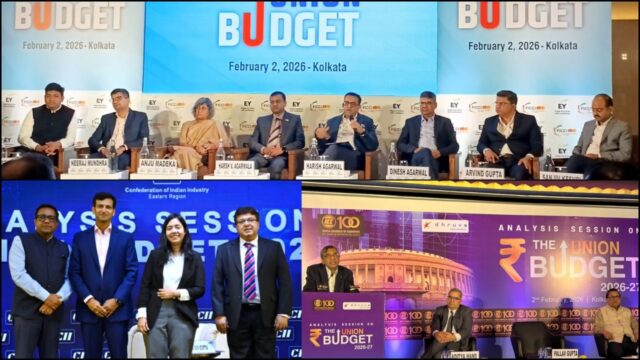
PARTHA ROY, KOLKATA: India’s leading industry bodies— Federation of Indian Chambers of Commerce and Industry (FICCI), Confederation of Indian Industry (CII), and Indian Chamber of Commerce (ICC)—held separate analysis sessions on the Union Budget 2026-27, focusing on its implications for taxation, fiscal policy, and sectoral growth on February 2, 2026, in Kolkata. The events gathered experts, policymakers, and business leaders to evaluate the budget’s emphasis on manufacturing, MSMEs, and sustainable development amid global uncertainties.
FICCI’s West Bengal State Council, in partnership with EY, hosted an interactive session examining the budget’s tax and industry impacts. Experts from EY provided detailed breakdowns, with Dinesh Agarwal discussing corporate tax provisions and Avisekh Jaiswal covering indirect tax measures. A panel of industry figures, including Harsh Vardhan Agarwala, Anju Madeka, Arvind Gupta, Neeraj Mundhra, and Sanjiv Kesthri, moderated by Harish Agarwal, debated sectoral effects. Agarwala described the budget as balanced and credible, prioritizing growth, inclusivity, and youth empowerment through ongoing reforms and robust public capital expenditure. He noted its strong push for manufacturing, agriculture, and services, including the revival of 200 legacy industrial clusters and a Rs 10,000 crore SME Growth Fund to aid MSME modernization and expansion. Additionally, dedicated chemical parks and strategic initiatives were seen as enhancing opportunities in the plastics and polymer sector.
CII’s Eastern Region session featured Gaura Sengupta, Chief Economist at IDFC First Bank, who assessed taxation, fiscal measures, and sectoral priorities. She viewed the budget as pragmatic, ensuring business continuity with realistic revenue projections relative to GDP, increasing the chances of meeting tax targets. Sengupta highlighted sustained capital expenditure despite nearly half of total spending being fixed, moderated fiscal consolidation, necessary defense increases, declining debt levels, and unchanged 41% vertical tax devolution. Grants to deficit states were cut while promoting best practices via enhanced capital loans tied to GDP contributions. Shifting from last year’s consumption focus, this budget emphasizes production, infrastructure, and fiscal sustainability, with special attention to manufacturing and MSMEs through equity infusions. Subsidies represent about 9% of expenditure, and interest payments absorb nearly half of tax revenues. She stressed the need for reforms like deepening the bond market, boosting services exports, increasing labor participation, and improving productivity, alongside the budget’s skilling initiatives. Beyond the budget, the EU trade deal was noted for phased tariff reductions, offering competitive edges and adjustment time for Indian industries.
ICC’s session included Pallav Gupta, Aditya Hans, and Byasdeb Dasgupta, who praised the budget’s strategic balance, reform orientation, and focus on long-term structural resilience amid geopolitical challenges. Gupta called it tricky yet effective in controlling fiscal deficit, debt-to-GDP ratio, and inflation, with conservative tax projections likely to be surpassed, though warning of potential liquidity issues affecting deposit rates. He pointed to incentives for foreign and NRI investments in data centers, despite energy and water constraints. Hans stated the economy has regained momentum post-recovery, with strong GDP growth positioning India as the fastest-growing major economy, supply-driven inflation easing from falling food prices, and credible fiscal consolidation. Rupee depreciation stems from capital flows and growth-related imports, offset by services exports and remittances. The budget’s investment strategy boosts public capex in infrastructure and strategic areas like biopharma, semiconductors, electronics, chemicals, and construction equipment to elevate value chains. Dasgupta emphasized the move away from short-term freebies toward sustainable, capital expenditure-led growth in urban development, MSMEs, and human capital, viewing it as a developmental blueprint to address structural bottlenecks and foster market-driven expansion.