
PARTHA ROY, KOLKATA: India’s traditional joint family system, a cornerstone of social and economic stability, is rapidly evolving into nuclear families. With children relocating to distant cities or abroad for higher education and lucrative jobs, parents often find themselves managing assets independently in their later years. This geographical and emotional dispersion heightens the risk of inheritance disputes, prolonged litigation, and family discord. In such a dynamic scenario, proactive inheritance planning through robust legal instruments is no longer a luxury but a necessity for safeguarding wealth and preserving harmony.
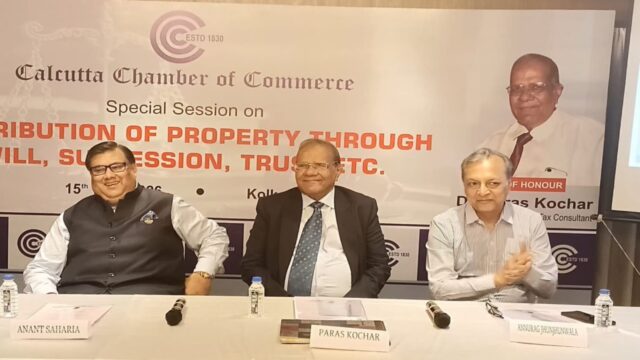
Eminent lawyer and tax consultant Dr. Paras Kochar delivered a highly insightful talk on inheritance planning on 15th May 2026 in Kolkata, organised by the Calcutta Chamber of Commerce. The session underscored practical strategies for modern families facing these transitions and more .
Several legal documents facilitate effective planning. A “Will” is the foundational instrument allowing a person to declare asset distribution after their demise. Importantly, a Will can be made by any person of sound mind, regardless of age (above 18 years), provided they possess testamentary capacity and mental clarity at the time of execution. A “Codicil” enables amendments to an existing Will without redrafting. A “Trust Deed” establishes a separate legal entity for asset management, offering privacy, professional oversight, and protection against hasty claims. Meanwhile, a “Deed of Family Settlement” promotes amicable division through mutual consensus, often executed during the lifetime to minimise future conflicts.
Central to a Will is the ‘appointment of an Executor’; by the testator. The Executor acts as the legal representative, responsible for locating assets, settling debts, paying taxes, and distributing property as per the testator’s wishes. A trustworthy and competent Executor ensures smooth execution and reduces family burden.
“Probate” — the court validation of a Will — historically added layers of time and cost, particularly in certain jurisdictions. However, the Repealing and Amending Act, 2025 (effective late 2025) deleted Section 213 of the Indian Succession Act, 1925, making probate no longer mandatory across India. This reform simplifies estate administration significantly, though parties may still seek it voluntarily for clarity in disputed cases.
Gender equality in inheritance has advanced notably for communities governed by the “Hindu Succession Act, 1956” — Hindus, Buddhists, Jains, and Sikhs. The 2005 Amendment granted daughters equal coparcenary rights in ancestral property by birth, aligning them with sons irrespective of marital status. This constitutional progress demands clearer documentation to prevent disputes arising from evolving family structures.
In an era of fragmented families, consulting professionals to draft these instruments ensures tax efficiency, minimises litigation, and honours personal wishes. Inheritance planning is ultimately an act of foresight, responsibility, and enduring love for future generations.